Canfit EP
2 Apr 2026
April is Parkinson's Awareness Month, and this year there is genuinely remarkable science to share. For years, exercise has been known to help people with Parkinson's disease (PD) manage their symptoms — improving balance, reducing falls, easing stiffness, and lifting mood. But a wave of recent research is pointing to something far more profound: exercise may not just manage the disease, it may actually change its course at the neurological level.
What Is Parkinson's Disease?
Parkinson's disease is a progressive neurodegenerative disorder in which the brain gradually loses its ability to produce dopamine — the chemical that carries movement signals from the brain to the muscles. By the time patients show the typical motor symptoms of Parkinson's, the neurodegenerative process has actually started much earlier, perhaps a decade or two prior, and patients have already lost over half of their dopamine-producing neurons.
Current medications can relieve symptoms, but as researchers note, they do not change the disease course. This is precisely what makes recent exercise research so exciting.
The Breakthrough: Exercise Actually Changes the Brain
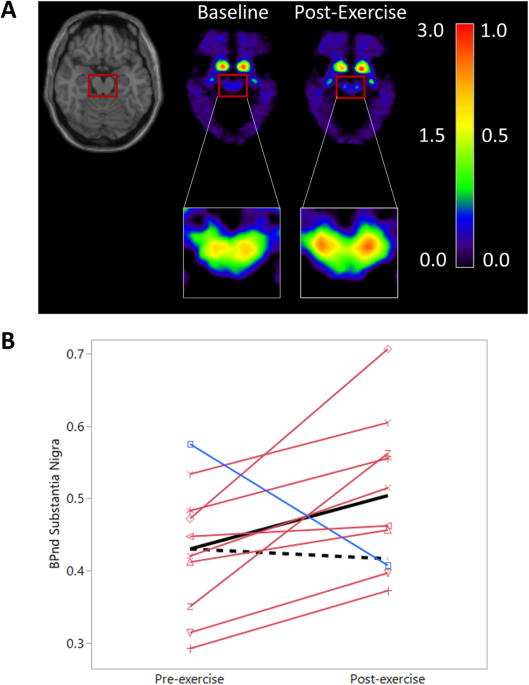
A landmark pilot study published in npj Parkinson's Disease (Yale School of Medicine, 2024) has, for the first time, used brain imaging to demonstrate that exercise can change the biology of the Parkinsonian brain itself.
Researchers evaluated the dopaminergic system of patients with mild and early PD before and after a six-month program of intense exercise. Using PET imaging, they measured dopamine transporter (DAT) availability, and using MRI, they evaluated neuromelanin content — both key markers of dopaminergic neuron health. Exercise reversed the expected decrease in DAT availability into a significant increase in both the substantia nigra and putamen. Exercise also reversed the expected decrease in neuromelanin concentration into a significant increase, suggesting improved functionality in the remaining dopaminergic neurons after exercise.
In plain terms: where the brain would normally have continued to decline, in nine out of ten participants, the dopaminergic system instead grew healthier and produced stronger dopamine signals. That was remarkable.
The results support the inclusion of high-intensity exercise early in the treatment plans of PD patients, and suggest a role for exercise as an effective non-invasive neuromodulatory therapy.
How Does Exercise Protect the Brain?
Recent research published in npj Parkinson's Disease (2025) identifies several mechanisms at work. Exercise offers neuroprotective benefits in Parkinson's disease by enhancing neurotrophic factors such as BDNF and GDNF, improving mitochondrial function, reducing inflammation, and promoting autophagy.
A particularly exciting discovery involves irisin — a muscle-derived protein released during exercise. Irisin links exercise to neuronal health by regulating mitochondria and reducing oxidative stress, and may even serve as a therapeutic target for patients who are unable to exercise.
Research published in Frontiers in Aging Neuroscience (2025) also shows that following physical exercise, there is a reduction in oxidative stress levels and an enhancement in mitochondrial function in the brain — both critical protective processes for dopaminergic neurons.
See the GLOSSARY below for key terms in bold.
What Type of Exercise Is Most Beneficial?
The research points to high-intensity aerobic exercise as particularly powerful for neuroprotection, but all forms of movement offer benefit. Current evidence supports:
High-intensity interval training (HIIT): Three sessions per week has been shown to improve dopaminergic signalling in the brain
Aerobic exercise (walking, cycling, swimming): Shown to slow motor symptom progression and improve quality of life
Resistance training: Builds strength and helps counter muscle rigidity
Balance and coordination exercises (Tai Chi, yoga, dance): Can optimise balance and mobility, and reduce fall risk
Dual-task training (combining movement with a cognitive challenge): Emerging evidence supports its benefit for both motor and cognitive symptoms
The key message from the research is that the earlier exercise is started and the more consistently it is maintained, the greater the neuroprotective benefit.
Reducing the Risk of Developing Parkinson's
The benefits of physical activity extend to prevention too. A large cohort study published in npj Digital Medicine (2024) followed over 80,000 individuals for more than 12 years. Both regular exercise and weekend warrior patterns of activity were equally effective at reducing Parkinson's risk — active individuals had a 42–56% lower risk of developing Parkinson's disease compared with inactive individuals.
The message is clear: it doesn't matter how you spread your movement across the week — what matters is that you move.
What This Means for You
If you or someone you know is living with Parkinson's disease, working with an Accredited Exercise Physiologist ensures your programme is carefully designed to:
Match the stage and severity of your condition
Safely progress intensity over time
Address both motor and non-motor symptoms
Maximise neuroprotective benefits
Exercise is no longer just a supportive add-on to Parkinson's management. The science now tells us it is a treatment in its own right — one that works at the level of the brain itself.
GLOSSARY
Dopamine: A chemical messenger in the brain that is essential for coordinating smooth, controlled movement. In Parkinson's disease, the neurons that produce dopamine gradually die off.
Substantia Nigra: A small region near the base of the brain that contains the majority of the brain's dopamine-producing neurons. It is the area most affected by Parkinson's disease.
Dopamine Transporter (DAT): A protein on dopaminergic neurons that helps regulate dopamine levels. DAT availability is used in brain scans as a marker of neuron health and function.
Neuromelanin: A dark pigment found inside dopamine-producing neurons. It can be measured by MRI and serves as an indicator of dopaminergic neuron health — higher levels indicate healthier neurons.
Neuroprotection: The process of preserving neuron structure and function, slowing or preventing further cell death in neurodegenerative conditions.
BDNF (Brain-Derived Neurotrophic Factor): A protein that acts like a fertiliser for the brain — supporting the growth, survival, and function of neurons. Exercise is one of the most powerful stimulants of BDNF production.
GDNF (Glial Cell Line-Derived Neurotrophic Factor): A protein that specifically supports the survival of dopaminergic neurons and has been shown to improve dopamine levels and neuronal health in Parkinson's models.
Irisin: A hormone-like protein released by muscles during exercise. Emerging research suggests it plays a role in protecting brain cells from the oxidative stress and inflammation associated with Parkinson's disease.
Autophagy: The brain's natural "clean-up" process — the way cells remove damaged components. Exercise promotes autophagy, helping to clear the toxic protein build-up that drives Parkinson's progression.
Oxidative Stress: Cellular damage caused by an imbalance between harmful molecules (free radicals) and the body's ability to neutralise them. Oxidative stress is a key driver of neuron death in Parkinson's disease.
SOURCE LIST
Source: de Laat B et al. Intense exercise increases dopamine transporter and neuromelanin concentrations in the substantia nigra in Parkinson's disease. npj Parkinson's Disease. 10:34 (2024). doi: 10.1038/s41531-024-00641-1
Source: Li WQ et al. Exercise as a multitarget therapy: modulating myokines, neurotrophins, and inflammation in Parkinson's disease. Frontiers in Aging Neuroscience. Vol 17 (2025). doi: 10.3389/fnagi.2025.1580029
Source: Lin F et al. Association of physical activity pattern and risk of Parkinson's disease. npj Digital Medicine. 7:137 (2024). doi: 10.1038/s41746-024-01135-3